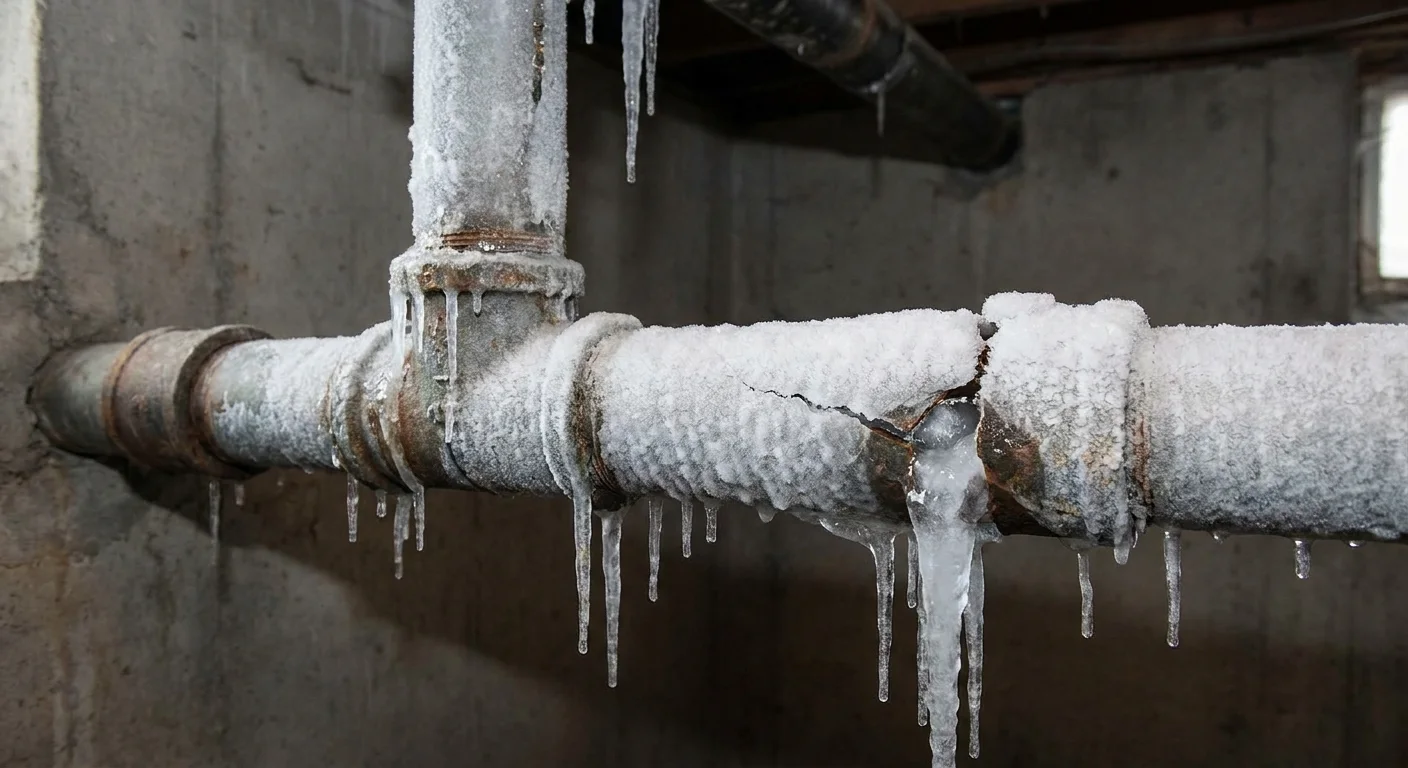
Here is what to do when pipes freeze: open the faucet that pipe feeds and warm the frozen section slowly, never with an open flame. If a pipe has already burst, shut off the main water valve, cut power to wet rooms if that is safe, photograph everything before you clean up, and call our 24/7 emergency line at (757) 520-5190.
The steps are simple. Knowing which situation you are in, and who handles each part, is the harder half. Hard freezes are not a weekly event in Chesapeake, Norfolk or Virginia Beach, so many homeowners never think about the water lines in their crawl space or exterior walls until one stops running.
We are AmeriTribe, a family-run restoration company based in Chesapeake. We are a one-stop shop: one call starts the water damage restoration, gets a plumber to the pipe if you do not have one yet, and carries through the insurance claim and the rebuild.
Quick answer: frozen pipe, burst pipe, claim and drying
| Situation | Do this now | Who to call |
|---|---|---|
| Pipe frozen, no leak | Open the faucet it feeds, warm the pipe gently (no open flame), open the sink cabinet doors. | You, or call us and we will get a plumber out if you cannot reach the frozen section |
| Pipe burst | Shut the main water valve, turn off power to wet rooms if safe, move valuables, take photos. | AmeriTribe. We get a plumber out if you need one, handle the water and guide you through the claim |
| Insurance | Report it quickly and keep your photos. Most policies cover sudden and accidental discharge from plumbing if you took reasonable steps to prevent it (NAIC). | AmeriTribe. We guide you through the claim. |
| Drying deadline | Dry water-damaged materials within 24 to 48 hours to prevent mold (EPA). | AmeriTribe, 24/7 emergency line |
| Prevention | Thermostat at 55°F or higher, drip faucets in extreme cold, cover crawl space vents (FORTIFIED). | You, before the next hard freeze |
How do you know your pipes are frozen?
The surest sign is a faucet that gives little or no water during freezing weather while the rest of the house still has water.
Ice usually forms in one short stretch of pipe that sits in cold air. That is why the kitchen sink on an outside wall can stop while the bathroom runs normally. Watch for:
- Little or no water from one faucet, or from only the hot or cold side, when it is below freezing outside
- Frost on an exposed pipe in the crawl space, the garage or under a sink
- A toilet that refills slowly or not at all after a flush
Pipes freeze where heat does not reach them. The NAIC points to hard-to-reach places such as attics, crawl spaces and outside walls, and many homes in Chesapeake, Portsmouth and Suffolk run their water lines through exactly those spaces. A crawl space line that freezes and splits can leak for a while before anyone notices, because no one sees it.
No water and no leak means you can work calmly. Water on a ceiling, wall or floor means you should go straight to the burst-pipe steps below.
What to do when pipes freeze but have not burst
Open the faucet, warm the frozen section slowly with gentle heat, and call us if you cannot find or reach it.
If you can see and reach the pipe, these steps keep you safe while it thaws:
- Open the faucet the pipe feeds so melting water has somewhere to go.
- Open the sink cabinet doors so room air reaches the pipes, as FORTIFIED, a program of the Insurance Institute for Business & Home Safety (IBHS), recommends.
- Warm the frozen section with a hair dryer, or a space heater kept well clear of anything that can burn. Never use a torch or any open flame.
- Check the other faucets. If one line froze, another in the same wall or crawl space may have too.
- Find your main water shutoff before the ice melts, in case the pipe has cracked.
- Call AmeriTribe if water does not come back, you cannot find the frozen section, or you see a split or bulge in the pipe.
Once water runs again, watch the pipe and the floor below it for a few hours. A pipe can crack while frozen and only leak once water moves through it again. If the frozen spot sits behind a finished wall or ceiling, do not cut into it; call us and keep towels and a bucket nearby.
A pipe burst: what to do in the first hour
Stop the water, make the room safe, and photograph everything before you move or throw anything away.
- Shut the main water valve. Look where the water line enters the house, often in a crawl space, garage, utility closet or near the water heater. Closing it stops the flow to every pipe at once.
- Turn off power to wet rooms, only if that is safe. Use the breaker panel only if you can reach it without standing in water. Otherwise, stay out of the wet area and tell us when you call.
- Move what you can. Lift rugs, electronics, papers and photographs off wet floors.
- Take photos and video. Get every wet room, the ceilings, walls and floors, damaged belongings and the broken pipe itself.
- Make one call. AmeriTribe gets a plumber out if you need one, handles the water and guides you through the claim, so you are not chasing three companies.
The photos matter. Most of the homeowners we help are filing their first insurance claim, and the adjuster may not see the house until the water is gone. Your pictures show how far the water spread and what caused it, so take them before you mop, pull up carpet or haul anything to the curb. We write insurance estimates in Xactimate, and those first photos back them up.
For what comes after the first hour, including what to tell your insurer, our first 48 hours checklist walks through it step by step.
Who do you call first: a plumber, your insurer or a restoration company?
Call AmeriTribe. We are a one-stop shop, so one call covers every part of a burst pipe, and if no plumber is on the way yet, we will get one out.
- The pipe: if you do not have a plumber on the way, tell us. We have plumbers and will get one out.
- The water damage: extraction, structural drying and dehumidification, then the rebuild that puts the rooms back together.
- The claim: we guide you through it, from the first report to your insurer through the adjuster visit.
If water is still running after you close the main, or it is coming through a ceiling, tell us when you call so the crew knows what it is walking into.
This is where many homeowners get stuck. Other restoration companies dry the structure and open the walls, then tell you to hire someone else for the asbestos, mold or sewage. AmeriTribe is a Virginia Class A contractor, the state's highest license tier, with no limit on the size of a single project. We run every trade ourselves, from mitigation through the rebuild, so you never have to act as your own general contractor.
Emergency response is available 24/7, whatever time the pipe gives out. Our office hours are 9:00 AM to 4:00 PM.
Why the next 24 to 48 hours decide whether mold follows
The EPA says water-damaged areas and items should be dried within 24 to 48 hours to prevent mold growth, and a burst pipe soaks far more than what you can see.
Water from a broken supply line spreads sideways and down, into materials that look dry on the surface:
- Drywall and insulation inside exterior walls
- Subfloor and framing over a crawl space
- Carpet pad under carpet that only feels damp
- The bases of kitchen and bathroom cabinets
In humid South Hampton Roads, a soaked wall cavity or crawl space is slow to dry on its own, so we rely on structural drying and dehumidification rather than waiting on the weather.
If mold does start, visible growth usually means a larger colony behind the wall, and painting over damp drywall without fixing the moisture source lets mold grow underneath until the paint bubbles. Mold testing on our jobs is always done by an independent third party, so the results stand up with your adjuster. Our mold remediation work handles containment, removal and prevention from there.
Older homes add one more check. Houses built before 1980 can contain asbestos in floor tile or pipe insulation, so we test suspect materials before wet materials come out. As a licensed Virginia asbestos contractor (DPOR 3306001176), we keep working instead of handing you off. Our asbestos removal page explains more.
How to keep pipes from freezing again this winter
Keep heat on your pipes and cold air off them, starting with a thermostat set to at least 55°F.
- Set the thermostat to 55°F or higher, including when you are away.
- Add temperature monitoring that alerts you if the house gets cold, and have backup heat ready.
- Let faucets drip during extreme cold.
- Keep sink cabinet doors open on cold nights.
- Insulate pipes in the crawl space.
- Cover crawl space vents before a hard freeze.
- Disconnect garden hoses.
These come from FORTIFIED and the IBHS tips the NAIC shares with homeowners. In Chesapeake, Virginia Beach and Suffolk, the crawl space vents are an easy step to forget, because most of the year nobody thinks about them. Cover them when a freeze is in the forecast.
These steps also matter in a claim, because insurers generally expect the home to be kept heated.
Will homeowners insurance cover a pipe that burst from freezing?
Many policies do, but coverage depends on your policy and on the steps you took to protect the home.
According to the NAIC, policies generally cover a sudden and accidental discharge from plumbing. They also generally require a minimum temperature in the home, or the water shut off if it is vacant, and neglect can lead to a denied claim. What helps:
- Reporting the damage to your insurer promptly
- Photos and video taken before cleanup
- Showing the house was heated, or the water shut off if it sat empty
- Starting the drying right away so the damage does not spread
Waiting costs you twice: water that sits past the 24 to 48 hour window gives mold a foothold.
We will not guess at what your policy pays. We help you find out, walking you through the adjuster visit, your deductible and temporary housing, and advising on rebuild choices such as matching continuous flooring, where an insurer might otherwise cut corners. Our insurance claims page explains how.
Why homeowners across South Hampton Roads call AmeriTribe
Homeowners call AmeriTribe because one licensed, insured company handles the whole job, from the first call through the rebuild. Most are filing their first claim and want someone to take charge.
- Virginia Class A Contractor, DPOR license 2705142434. Class A is Virginia's highest contractor license tier, with no limit on the size of a single project.
- Virginia Asbestos Contractor License, DPOR 3306001176. Each worker also holds an individual asbestos license, renewed every year.
- Licensed and insured. Coverage includes commercial general liability, pollution liability, professional liability, commercial auto, umbrella and workers' compensation.
- One roof, start to finish. Water, mold, asbestos and the rebuild, handled by the same company.
- Guidance through the claim. Adjusters, deductibles, temporary housing and rebuild choices, explained in plain terms.
- Native American-owned and family-run. A core team of 11 based in Chesapeake that sponsors local youth wrestling and baseball teams.
Before you hire any restoration company, ours included, check the contractor license, ask for the certificate of insurance and ask for references. Both of our licenses can be looked up at dpor.virginia.gov. A licensed, insured contractor protects you from operators who take a deposit and disappear.
Burst Pipe in Chesapeake, Virginia Beach or Norfolk? Call Our 24/7 Water Damage Line
If there is water on your floor right now, call us at (757) 520-5190 and we will take it from there. Emergency response is available 24/7, and our office hours are 9:00 AM to 4:00 PM.
When you call, we will:
- Walk you through the shutoff and safety steps
- Set up water extraction, structural drying and dehumidification
- Help you work with your adjuster and understand what your policy covers
- Stay with the job through the rebuild, one company from the first call to the final walkthrough
We serve Chesapeake, Virginia Beach, Norfolk, Portsmouth and Suffolk from our office at 908 Ventures Way, Suite B, Chesapeake, VA 23320.